
How to Choose a Gel Pack That Stays Flexible When Frozen
A gel pack stays flexible when frozen when the gel resists hardening and the pack is built to bend. Solid gel flexes as one piece; gel beads flex between the beads. Fill level, thickness and cover decide the rest — and one overnight freezer test verifies all three before you order.
Why do some gel packs freeze into a stiff board?
A gel pack is mostly water held in a gel. If the gel freezes solid, the pack comes out of the freezer as a flat board: it cannot wrap a knee, sit on a shoulder or stay against an ankle, and the user ends up holding it in place by hand. Three things decide whether that happens:
- The gel itself. Gels formulated to stay pliable below 0 °C bend after freezing; plain water-rich gels set hard.
- The format. In a bead pack, each bead freezes on its own, so the pack still moves between the beads. In a solid gel pack, the whole sheet flexes as one piece.
- The fill level. An overfilled pack has no room left for the gel to shift, so even a flexible gel freezes rigid. Fill weight per size is a specification worth asking for.
Which format flexes better: solid gel or gel beads?
Both formats can stay flexible; they flex in different ways, and they suit different products. The two published examples below are from the Hot & Cold Therapy Packs range.
| Solid gel | Gel beads | |
| How it flexes | One seamless piece bends as a sheet | Beads move against each other inside the cover |
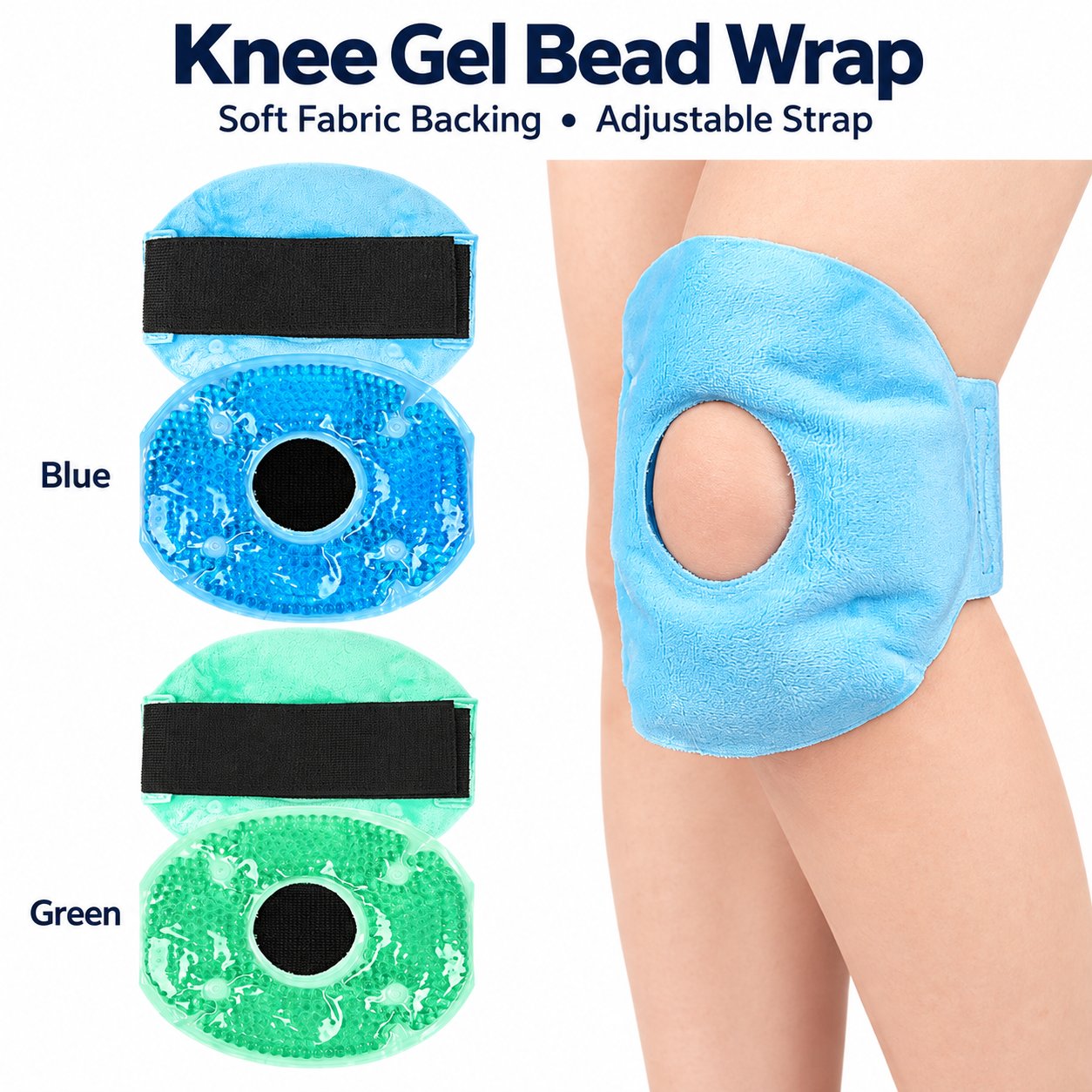
| Fit | Slides on, covers the joint and surrounding muscles | Moulds around the kneecap; strap holds it in place |
| Published example | Solid Gel Sleeve, 4 sizes (S–XL), 452–840 g | Knee Gel Bead Wrap, 2 sizes, pad 1.25 cm thick |
| Freezer preparation | Chill 1–2 hours in a freezer bag | Freeze 15–30 minutes; knead gently so beads spread evenly |
| Heat use | Microwave 45 seconds, then 5-second intervals | Microwave on medium-low in 10-second intervals only |
For sleeves and joint wraps that a user wears while moving, the one-piece solid gel format keeps coverage even, with no straps. For a targeted joint such as the knee, beads plus a strap give a closer mould and let the user adjust compression.
What else decides whether a frozen pack bends?
- Thickness. A 1.25 cm gel pad bends around a joint far more easily than a thick block of the same gel. Match thickness to the body area: thin for joints, thicker for flat areas such as the back.
- Cover material. The bead wrap above pairs a PVC cover with a plush fabric backing; the film has to stay pliable at freezer temperature and not crack at the fold. Ask what film the pack uses and check it in the bend test below.
- Segmentation and straps. Channels, quilting and straps do not make the gel softer, but they hold a flexed pack against the body so the flexibility is actually used.
- Size. The largest size carries the most gel and is the stiffest case. If the largest size passes your flexibility test, the smaller sizes will too.
How do you test flexibility before ordering?
Run this bend test on samples of the exact size you plan to sell:
- Freeze the pack flat at −18 °C for 12 hours — overnight, not just the minimum chill time on the instructions, because retail customers leave packs in the freezer for days.
- Take it straight from the freezer and wrap it around the joint or product form it is made for. Do not let it warm up first.
- Pass marks: it bends without cracking or white stress marks on the film, the gel redistributes when kneaded, and the seams and strap welds stay intact.
- Repeat for three freeze–thaw cycles and test again. Some films and gels pass the first freeze and stiffen or split later.
- Test the largest size, and test the pack the way a customer would — including microwaving it after freezing, if the product is sold as hot & cold.
What should you confirm with the supplier?
- Gel format (solid gel, beads, or another fill) and the fill weight for each size
- Cover and backing materials, and the film's behaviour at −18 °C
- The freezer and microwave instructions that will be printed on the retail packaging
- Test reports and MSDS — on the bead wrap line above, these are available on request
- Customisation: on these lines, custom colours, logo printing and retail packaging are published options, and sizes can be adapted to your program
If you are building a hot & cold range and want the flexibility test run on a specific size first, contact us with the body area and size you have in mind.
FAQ
How long does a gel pack need in the freezer?
It depends on the format. The gel bead wrap above freezes in 15–30 minutes (or refrigerates in 30–60 minutes); the solid gel sleeve chills in 1–2 hours. Follow the instructions printed for the specific pack, and test overnight freezing separately — that is how customers will actually store it.
Does a pack that stays flexible stay cold as long?
Flexibility and cold time pull in opposite directions. More gel mass holds cold longer — the solid gel sleeve runs from 452 g in size S to 840 g in XL — while a very soft, thin pack gives up its cold faster. Wraps for joints need flex first; a heavy flat pack for a back can trade some flex for cold time.
Can a flexible gel pack also be used hot?
Yes, if it is built as a hot & cold pack. Both formats above carry microwave instructions: the bead wrap heats on medium-low power in 10-second intervals only, and the solid gel sleeve heats for 45 seconds, then in 5-second intervals. Never heat a pack for 1–2 minutes at once.
What freezer temperature should the bend test use?
Use −18 °C, the standard household freezer setting, and freeze for a full 12 hours. A pack that only stays flexible after the short chill time in its instructions has not been tested the way customers will use it.
Can a flexible gel pack carry our own brand?
Yes. On the lines above, custom colours, logo printing and retail packaging are published options, and sizes can be adapted. Confirm the printed instructions and warnings for your market when you confirm the packaging.
 Gel Pillow Inserts: Sizes, Shapes and Integration Methods
 Cooling Gel Mattress Toppers: An OEM Buying Guide
